Prosthetic dental treatment is a field where missing teeth and/or teeth with advanced structural loss are restored to regain function and aesthetics through “prosthetic restorations.” Although the term prosthesis is often colloquially known as “dentures,” in modern dentistry, prostheses include not only removable full or partial dentures but also fixed prostheses (crowns, bridges), implant-supported prostheses, and various types of removable prostheses with different retention systems. Therefore, prosthetic dental treatment is a comprehensive field that involves planning and laboratory work and can be applied to a wide range of patients, from those missing a single tooth to those without any teeth.
Missing teeth are not only an aesthetic issue. Over time, adjacent teeth may tilt into the gap, opposing teeth may over-erupt, chewing balance may be disrupted, and in some patients, additional stress can occur on the temporomandibular joint and chewing muscles. Especially in cases of multiple tooth loss, changes in facial profile, reduction in lip and palate support, and loss of vertical dimension of occlusion (bite height) may be observed. Prosthetic dental treatment aims to compensate for these losses to achieve a more balanced bite, more efficient chewing, and a more natural appearance.
Prostheses are basically divided into two categories: fixed and removable. Fixed prostheses cannot be removed by the patient; they are cemented or screwed onto teeth or implants. Crowns and bridges fall into this group. Removable prostheses can be taken out and put back in by the patient; partial dentures (with clasps), complete dentures, and implant-supported removable prostheses belong to this group. The choice of prosthesis type depends on the number of missing teeth, the condition of existing teeth and bone tissue, the patient’s hygiene habits, aesthetic expectations, occlusal relationship, and overall treatment goals.
In a successful prosthetic treatment, impressions, bite records, try-in phases, and final adjustments are critical. Additionally, the prosthesis must be cleanable, compatible with the gums, correctly transmit chewing forces, and provide comfort for daily use by the patient. For these reasons, prosthetic dental treatment is not a “one-appointment procedure” but a rehabilitation process planned individually with controlled stages.
What Is Prosthetic Dental Treatment?
Prosthetic dental treatment is the general term for therapeutic methods that restore dental deficiencies or teeth requiring extensive restoration by means of custom-made prosthetic restorations to regain oral functions and aesthetics. This treatment encompasses a wide range, from covering a single tooth with a crown to filling multiple missing teeth with bridges; from fixed implant-supported teeth to complete dentures. The core objective is to sustainably improve the patient’s chewing, speech, and smile aesthetics.
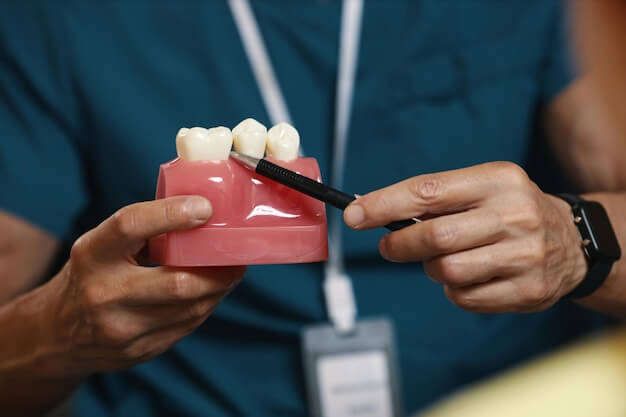
Prostheses are mainly categorized into fixed and removable types. Fixed prostheses are anchored onto teeth or implants and cannot be removed by the patient. A crown covers all or most of a tooth; a bridge closes a missing tooth gap by being supported by adjacent teeth or implants. Removable prostheses are those that the patient can insert and remove; these include complete dentures (for edentulous jaws), partial dentures (for partial tooth loss), and implant-supported removable prostheses.
Prosthetic dental treatment is not just “making teeth.” Establishing correct occlusion, ensuring harmony with gums and soft tissues, cleanability, balanced distribution of masticatory forces, and aesthetic compatibility are all evaluated together. Therefore, prosthetic treatment is a carefully planned rehabilitation involving examination, impression taking, and try-in stages performed meticulously.
How Is Prosthetic Dental Treatment Applied?
The application of prosthetic dental treatment varies according to the selected prosthesis type; however, the basic workflow generally consists of examination and planning, impressions and records, try-in, delivery, and follow-up stages. At the first appointment, a detailed examination is performed: the position of missing teeth, restorative condition of existing teeth, gum health, bone support, and occlusal relationship are evaluated. If necessary, panoramic X-rays and/or regional radiographs are taken. The choice of prosthesis is then determined based on these findings.
The decision on the most suitable option (fixed/removable/implant-supported) is made based on these data.
If a fixed prosthesis is planned, the abutment teeth are prepared (preparation) and impressions are taken. Impressions can be made using conventional materials or digital scanning. In most cases, temporary restorations are applied; these preserve aesthetics, protect the teeth from sensitivity, and help stabilize the gingival form. During the laboratory phase, the prosthesis is manufactured using CAD/CAM or traditional methods. At the try-in appointment, the marginal fit, contacts, and occlusion are checked; after necessary adjustments, the delivery is completed with cementation or screwing.
In removable prostheses, impression taking and recording the jaw relations involve more distinct steps. Preliminary and final impressions are taken; the jaw relation is determined with an occlusal record. A teeth arrangement try-in is performed: the smile line, lip support, phonetics (especially the “s” and “f” sounds), and occlusion are checked. After the try-in, the laboratory completes the prosthesis and it is delivered. Since pressure sores may appear especially in the first 1–2 weeks post-delivery, control appointments are scheduled; small adjustments are made to ensure comfort in terms of tissue adaptation.
In implant-supported prostheses, the process may be extended depending on implant surgery and the healing period. Once the implant has fully osseointegrated, impressions for the superstructure are taken, a try-in is performed, and the prosthesis is fixed. The final step for all prosthesis types is providing the patient with proper usage and hygiene instructions; this education is essential for the long-term success of the prosthesis.
Who Is Suitable for Prosthetic Dental Treatment?
Prosthetic dental treatment is suitable for many patients with missing teeth or severely damaged existing teeth; however, suitability is assessed according to the type of prosthesis selected. For a single missing tooth, fixed restoration (implant-supported crown or a bridge in suitable cases) can be planned. In cases of multiple missing teeth, fixed bridges or implant-supported solutions can be preferred. In total edentulism, complete dentures or implant-supported complete dentures are considered.
Oral tissue health is a fundamental criterion in suitability assessment. If there is active gingival inflammation, periodontitis, heavy calculus, or uncontrolled caries, these issues must be treated first. Prostheses are in constant contact with the gingiva and supporting tissues; prostheses placed over unhealthy tissues increase the risks of bleeding, odor, incompatibility, and rapid complications. Additionally, oral hygiene habits are critically important, especially with fixed bridges and implant-supported prostheses. The patient should be able to maintain interdental cleaning and regular check-ups.
Bone support is specifically evaluated in patients considered for implants. If the bone volume is insufficient, additional surgical procedures may be necessary, or the prosthetic plan may be shifted towards removable solutions. In removable prostheses, the shape of the alveolar ridges affects retention and comfort. Patients who can regularly insert and remove their prosthesis, perform cleaning, and adapt during the adjustment period achieve better results with removable prostheses.
Systemic diseases are often not a contraindication for prosthetic treatment; however, especially if surgery (implant) is planned, the general health condition, medications used, and healing capacity are assessed by the clinician. In conclusion, prosthetic dental treatment can be applied to a very wide patient group with appropriate patient selection and accurate planning.
What Should Be Considered Before Prosthetic Dental Treatment?
The first matter to consider before prosthetic dental treatment is controlling oral infections and diseases. If there are caries, broken restorations, abscesses, gingival bleeding, or periodontitis, these problems must be treated before prosthetic procedures. It becomes more difficult to manage these conditions after prosthesis placement, and they may shorten the lifespan of the prosthesis. Particularly in fixed prostheses, the strength of the abutment teeth forms the foundation of the treatment; if these are weak, bridges or crowns become risky in the long term.
The second matter is accurate planning and managing patient expectations. The patient’s expectations should be clearly determined in prosthetic treatment: more Natural color or a whiter appearance; fixed or removable preference; usage comfort and hygiene habits are important topics in treatment selection.
In cases of multiple missing teeth, if there is a loss of jaw closing height, this height must be re-established carefully and controlled. Since the trial stages are critical in this process, it is important for the patient to attend appointments regularly.
If a removable denture is planned, it is necessary to be prepared for the adaptation period. In the first few days, changes in speech, increased saliva production, pressure sores, and an adjustment period in chewing habits may occur. If the patient is informed before treatment that this process is normal, they adapt more comfortably to the treatment. In fixed prostheses, there may be a temporary restoration period; during this time, care should be taken with hard and sticky foods to reduce the risk of breaking or dislodging the temporary restoration.
If an implant plan exists, smoking habits and overall health status must be evaluated. Smoking may adversely affect soft tissue healing; the clinician may recommend reducing or pausing smoking before treatment. Proper preparation before prosthesis both increases treatment comfort and supports the long-term success of the prosthesis.
What to Pay Attention to After Prosthetic Dental Treatment
After prosthetic dental treatment, a maintenance and control routine is essential for the longevity and comfort of the prosthesis. In fixed prostheses (crowns, bridges, implant-supported fixed prostheses), the most important issue is interdental cleaning. If plaque accumulates at the gingival margins and under the bridge, the risk of gingival inflammation and secondary caries increases. Therefore, dental floss, bridge thread (super floss), interdental brushes, and oral irrigators should be used regularly as needed. The cleaning method recommended by the dentist should be personalized according to the design of the prosthesis.
In removable prostheses, the prosthesis must be removed and cleaned daily. Prostheses should be cleaned with special denture brushes and suitable cleansers; abrasive toothpastes can scratch some prosthetic surfaces and should be used carefully. Pressure sores, speech changes, or denture irritation might be noticed in the first days. In such cases, instead of attempting to adjust the prosthesis yourself, you should come to the control appointment. It is normal to have several adjustment appointments within the first week after delivery and as needed in the following weeks.
Chewing habits are also important. It is recommended to start with soft foods in the first days and regain the habit of chewing on both sides. Breaking very hard foods at a single point can increase the risk of fractures or poor fit in prostheses. For implant-supported prostheses, if bruxism is present, using a night guard helps protect the superstructure.
Regular check-ups are part of prosthetic treatment. During check-ups, gingival health, prosthesis margin fit, occlusal balance, and (if implants are present) the peri-implant tissues are evaluated. Early identification of minor misfits can prevent larger problems. With proper cleaning, correct use, and regular follow-ups, prostheses can be used safely for many years.
When Is Prosthetic Dental Treatment Applied?
Prosthetic dental treatment is applied in patients with missing teeth or severely damaged tooth structure. In single tooth loss, the gap can be restored with fixed restorations (implant-supported crown or bridge). In multiple missing teeth, depending on the extent of loss, fixed bridges, implant-supported fixed prostheses, or removable partial dentures may be preferred. In complete edentulism, complete dentures or implant-supported complete dentures can be planned.
Prosthetics may also be necessary in cases where teeth are excessively worn, fractured, or have large fillings/root canal treatments. For example, if a large portion of the tooth is lost, sufficient strength may not be achieved with fillings alone, and the goal becomes protecting the tooth with a crown. In some patients, renewing old, ill-fitting crowns also falls under prosthetic dental treatment. Furthermore, in cases with severe occlusal disturbances, vertical dimension loss, or needing aesthetic-functional rehabilitation, a “full mouth prosthetic planning” may be done.
Removable prostheses are preferred for patients who cannot have implants and It is an important alternative for patients who do not want implants. Particularly in patients using complete dentures and complaining about the retention of the denture, removable dentures supported by a few implants can significantly increase comfort. Conditions such as congenital tooth absence, tooth loss after trauma, or advanced periodontal loss are also indications for denture treatment. Which denture is appropriate in which case is clarified through examination and radiographs.
Why Is Denture Treatment Performed?
Denture treatment is performed to restore functional losses caused by missing teeth, maintain oral balance, and improve aesthetic appearance. Missing teeth reduce chewing efficiency and may lead the patient to chew unilaterally. This situation can cause fatigue in the chewing muscles, overload certain teeth, and lead to occlusal disorders over time. When missing teeth are replaced with dentures, chewing becomes more balanced and nutritional comfort increases.
From an aesthetic standpoint, especially in the anterior region, missing teeth can affect a person’s self-confidence and social life. In cases of multiple tooth loss, lip support decreases, the facial profile collapses, and an older appearance may develop. Denture treatment can restore lip-palate support and facial proportions. Additionally, speech can be affected by tooth loss; dentures provide phonetic support aiming for clearer articulation of certain sounds.
From a biomechanical perspective, dentures help prevent tilting of adjacent teeth and the elongation of opposing teeth. If a missing tooth gap remains unfilled for a long time, teeth may shift position, spaces can widen, food impaction increases, and gum problems may develop. Denture treatment aims to prevent these chain reactions.
Finally, dentures are also applied to “protect” certain teeth. Teeth with extensive material loss can be reinforced with crowns, thereby reducing the risk of fracture. A well-planned denture is a rehabilitation that supports function, aesthetics, and oral health in the long term.
How Long Does Denture Treatment Take?
The duration of denture treatment varies depending on the type of denture, the number of restorations to be performed, necessary additional treatments, and the need for try-in sessions. In fixed prostheses (crowns-bridges), the process can usually be completed in 2–4 appointments: preparation and impression, temporary restoration, try-in, and delivery. If aesthetic expectations are high or multiple teeth are to be restored simultaneously, the number of try-ins and revisions may increase.
In removable dentures, the process generally includes impression, jaw relation (occlusion) record, tooth arrangement try-in, and delivery stages. Several follow-up appointments may be needed within the first 1–2 weeks after delivery; these controls are important for relieving pressure sores and improving adaptation. In multiple tooth loss with vertical dimension reduction, testing occlusion with trial plates may prolong the treatment time; however, these stages are valuable for comfort and success.
In implant-supported dentures, the total duration depends on implant surgery and the osseointegration period. After implant osseointegration is completed, the superstructure stage usually proceeds in a few appointments. Additionally, healing after extractions, gum treatments, or bone grafts can add extra time to the treatment schedule. The most accurate duration will be determined specifically for you after the examination and final planning.
Denture Treatment Prices
Denture treatment prices vary according to the type of denture to be made (fixed, removable, implant-supported), the number of missing teeth, materials used, the extent of laboratory work, number of impressions and try-in sessions, and additional procedures that may be required before treatment (extraction, root canal treatment, periodontal therapy, implant surgery, bone graft, etc.). Therefore, giving a “single price” without examination is not correct; there may be very different treatment plans under the same category.
For example, a single crown for one tooth, a partial denture in multiple tooth loss, or an implant-supported fixed prosthesis have different workflows and cost items. In removable dentures, options such as metal framework design, precision attachments, or implant support
The cost can be affected. In fixed prostheses, the number of restorations, material choice, and the level of aesthetic characterization are the determining factors.
To receive up-to-date and personalized information about prosthetic dental treatment prices, you should contact us. After an examination, we will transparently share the most suitable prosthesis option for you, the treatment steps, and the associated cost plan.