
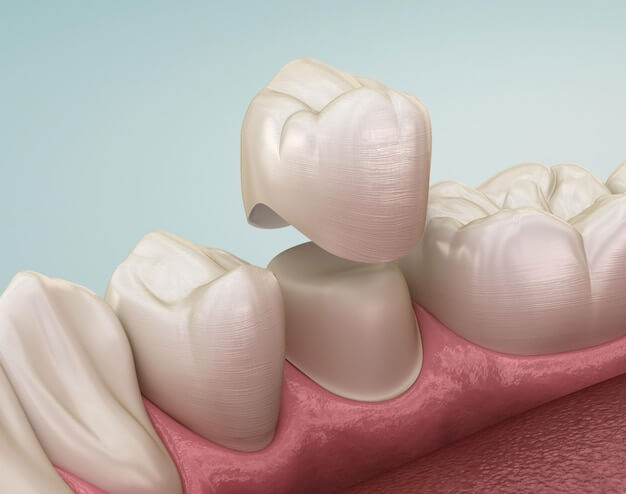
Dental crown treatment is a general term for fixed restorations that cover the visible part of the tooth (the crown) and are applied for both aesthetic and functional purposes. While the term “crown” is often thought to refer to a single option in everyday language, there are various types of crowns planned with different materials and indications in the clinic. Porcelain-fused-to-metal crowns, full ceramic crowns (such as e-max/lithium disilicate), zirconia-based crowns, or in some cases composite-based solutions are chosen according to criteria such as the tooth’s position, aesthetic expectations, biting forces, and the condition of the dental tissue.
The main goal of crown treatment is to strengthen a weakened tooth or one with shape/color defects by encasing it like a protective shell while providing a natural appearance. Crowns are an important restorative approach to reduce the risk of fracture in teeth with large fillings, risk of cracks, or root canal treatment. From an aesthetic perspective, crowns can be planned as part of a smile design in cases where the form is distorted, the color has changed permanently, or there are harmony issues between teeth. In the anterior region, translucency and natural appearance become more critical in crown selection, while in the posterior region, durability and occlusal compatibility are more prominent.
Crown planning involves not only “placing a crown on the tooth” but also evaluating gum health and occlusal balance together. This is because the marginal fit of the crown, its relationship with the gums, and its cleanability are fundamental for long-term success. Poorly fitted crowns at the margins can increase plaque accumulation and lead to gum problems. Likewise, if occlusal relationships are not properly adjusted, excessive loading may occur on the crown, causing cracks, fractures, sensitivity, or gum recession over time. Therefore, crown treatment is not merely an aesthetic procedure; it is a restorative treatment requiring correct biomechanical planning.
The treatment process usually includes taking impressions, using temporary crowns, trial stages, and final cementation steps. In some clinics, digital impressions and CAD/CAM production can speed up the process; however, it should not be considered a same-day procedure in every case. The plan may vary depending on the tooth structure, the number of crowns to be made, and additional procedures (such as gum reshaping, fillings/root canal therapy, night guards for bruxism). With proper planning and regular check-ups, dental crowns provide solutions that can be reliably used for many years in terms of both aesthetics and function.
What Is Dental Crown Treatment?
Dental crown treatment is a fixed restoration procedure that completely covers the top part of the tooth, giving the tooth a new shape, color, and durability. The crown encircles the tooth 360 degrees and is also called a “crown.” The primary purpose is to protect a structurally weakened tooth, restore chewing function, and meet aesthetic expectations. A crown is not limited to filling a gap like a filling; it also allows for readjustment of the tooth’s shape, length, contact points, and occlusal relationships.
Crowns can be made from different materials, each with its advantages and limitations. Full ceramic crowns (for example, lithium disilicate) can provide more natural translucency in the anterior region and are preferred by patients with high aesthetic demands. Zirconia-based crowns are commonly used for their durability and biocompatibility and can be planned for both anterior and posterior regions. Porcelain-fused-to-metal crowns may be preferred in some cases for a balance of durability and cost; however, the aesthetic effects of the metal substructure should be carefully evaluated in the anterior region. The choice of material depends on factors such as tooth position, gum level, the patient’s smile line, biting forces, and habits like tooth grinding.
Crown treatment is not only a “cosmetic improvement” procedure. Teeth with large fillings or root canal treatment have weakened dental structure and increased risk of fracture. In such cases, the crown acts as a protective coverage to strengthen the tooth.
How Is Dental Crown Treatment Applied?
Dental crown treatment usually consists of several clinical stages, each of which is important for the crown’s longevity and natural appearance. The process begins with the initial examination: the condition of tooth decay, existing fillings, gum health, occlusion, and esthetic goals are assessed. If necessary, an X-ray is taken to check the tooth’s root and surrounding tissues. If there is active decay, suspected cracks, gum inflammation, or the need for root canal treatment, these problems are addressed first because the crown must be placed on a “stable foundation.”
In the second stage, the tooth is prepared to make room for the crown (preparation). This procedure is performed under local anesthesia and aims to create enough space for the crown material thickness while preserving as much tooth structure as possible. The amount of preparation depends on the chosen crown material; for example, all-ceramic crowns require a certain minimum thickness for esthetics and durability. All surfaces of the tooth are shaped in a controlled manner, and the finish line (the boundary where the crown ends) is clearly defined. Correct positioning of this margin is critical for both gum health and crown edge adaptation.
Next, impressions are taken. Nowadays, impressions can be made using conventional impression materials or digital scanners. The impression is the fundamental data for the laboratory to produce the crown with micron-level precision. During the same appointment, temporary crowns are prepared for most patients. Temporary crowns protect the tooth from sensitivity, provide an esthetic appearance, and help maintain the gum’s form. The margin fit and contacts of the temporary crown are also important because poorly made temporaries can cause gum irritation or pain.
In the following appointment, the crown try-in is performed. The color, shape, gum compatibility, contacts with adjacent teeth, and occlusion are checked. Small adjustments are made if necessary. Once everything is satisfactory, the crown is cemented (bonded). The type of cement and bonding protocol used in this stage vary depending on the material; this stage determines long-term retention and sealing. Finally, occlusion is rechecked, and aftercare instructions are provided to the patient. Night guards may be recommended especially for patients with bruxism, as uncontrolled forces on the crowns can increase the risk of fracture.
Who Is Suitable for Dental Crown Treatment?
Dental crown treatment may be suitable for many patients with functional and esthetic needs; however, it is not appropriate for every tooth or every patient. Suitability assessment is based on the current condition of the tooth structure, gum health, occlusal balance, and patient expectations. Crowns are more commonly considered in cases such as: teeth weakened by large fillings, risk of tooth fracture or cracks, teeth treated with root canal therapy with considerable substance loss, severe wear of teeth, or noticeable esthetic irregularities in shape and color.
However, healthy gums are important for suitability. If there is active gum disease, bleeding, or heavy calculus buildup, periodontal treatment should be performed first. No matter how well the crown margins fit, if gum inflammation persists, it can lead to gum recession, sensitivity, and esthetic loss in the long term. Therefore, the crown should be considered as the “final procedure;” the oral foundation health must be stabilized first.
The structural condition of the tooth is also decisive. The tooth must have enough “retention” to support a crown. If the tooth is severely damaged, a crown alone may not be sufficient; supporting procedures such as a post and core may be necessary. In some cases, extraction and implant placement may be a more appropriate option. Decision is made based on X-ray and clinical examination. Additionally, in patients with tooth grinding or clenching (bruxism), crowns may be planned; however, in such cases, material selection, occlusal adjustment, and night guard protocol become more critical.
Esthetic expectation is also considered in the suitability assessment. When a crown is desired in the anterior region, tooth color, gingival level, smile line, lip movement, and harmony with adjacent teeth are evaluated together. Sometimes more conservative solutions (such as bonding or veneers) may be more appropriate instead of a crown; sometimes a crown is the more suitable option due to the structural needs of the tooth. In summary, suitability for a crown is as much about “indication” as it is about “desire”; the most accurate plan is made individually after examination and measurements.
What to Consider Before Dental Crown Treatment
The most important issue to pay attention to before dental crown treatment is to stabilize the overall oral health. If there are active caries, gingivitis, tartar accumulation, or untreated infections on the tooth to be crowned or on adjacent teeth, these must be treated first. Although a crown is a restoration that “covers and protects” the tooth, if the underlying tooth tissue continues to decay or gum health is compromised, long-term problems are inevitable. Therefore, professional dental cleaning and oral hygiene education are frequently recommended before crown placement.
Secondly, an occlusion (bite) evaluation must be performed. Crowns that receive incorrect contacts during occlusion may have an increased risk of cracking or fracture; they can also adversely affect the temporomandibular joint and muscles. In patients with suspected tooth grinding or clenching (signs such as tooth wear, morning jaw fatigue, headaches), the dentist includes this in the treatment plan. If necessary, night guard treatment is discussed as part of the plan. The durability of the crown depends not only on the material but also on the proper distribution of occlusal forces.
From an esthetic planning perspective, clarifying the patient’s expectations is important. Is “whiter” desired, “longer” teeth, what should be the shape of the teeth, are there irregularities in the gingival margin? The answers to these questions determine the color and shape of the crown. In some patients, tooth whitening may be planned before crown placement; since the color of individual crowns is selected relative to the existing tooth shade. If a general shade lightening is targeted, performing whitening first and then determining the crown color can yield more consistent results (if deemed appropriate by the dentist).
Practical preparations before crown treatment are also important: the treatment may require several appointments; caution is advised with hard and sticky foods during the temporary crown period. Also, since short-term sensitivity may occur after the procedure, scheduling intensive activities accordingly is advisable. Lastly, taking X-rays and necessary photographs before crown placement is beneficial for both diagnosis and objective monitoring of treatment. Proper preparation significantly enhances the esthetic and biological success of the crown.
What to Consider After Dental Crown Treatment
Post-treatment care is crucial in prolonging the lifespan of the crown and preserving gingival health. Mild sensitivity may be experienced in the first days after the crown is placed; especially sensitivity to hot and cold or slight discomfort when chewing. This usually decreases within a short time; however, if pain increases, there is throbbing pain that wakes the patient at night, or a noticeable feeling of high occlusion, the control appointment should not be delayed. When the crown is high, excessive load can damage both the tooth and crown.
Within the first 24–48 hours, being cautious with very hard foods is beneficial for the complete setting of the bonding cement and adaptation of the tissues. Especially since the temporary crown phase has just ended, patients may feel “now I can eat everything comfortably,” yet controlled eating habits in the initial days create a good routine. Although crowns are highly resistant to fracture, habits such as cracking nuts with teeth, chewing ice, or opening hard packages with teeth should be avoided.
Habits can increase the risk of cracks in crowns.
Oral hygiene is the most critical factor for the success of the crown. The crown covers the tooth; however, there is a “margin” at the gum line where plaque accumulation is most common. Therefore, brushing at least twice a day and using dental floss or interdental brushes after crown placement is important. Regardless of how well the crown margin fits, poor oral hygiene increases the risk of gum bleeding, recession, and marginal leakage over time. Especially for patients with multiple crowns, interdental cleaning should become a habit.
Follow-up checks are necessary for long-term success. For patients who grind or clench their teeth (bruxism), wearing a night guard is often a critical protective measure. Bruxism applies different and more intense forces to the crown than normal chewing forces, which can increase the risk of cracks or fractures in the porcelain. Additionally, during regular dental examinations, the crown margins, gum health, occlusal balance, and any discolorations are monitored. Crowns are not a “set and forget” treatment; with proper care and regular check-ups, they can remain stable for many years.
In Which Cases is Dental Crown Treatment Applied?
Dental crown treatment is applied when the tooth is structurally weakened or needs to be reshaped for aesthetic or functional reasons. One of the most common indications is teeth with large restorations. When a significant portion of the tooth has been restored with a filling, the remaining natural tooth structure becomes more prone to fractures. In such cases, the crown aims to encase the tooth completely to reduce the risk of fracture and to distribute chewing forces more evenly.
Teeth that have undergone root canal treatment also frequently require crowns. After root canal therapy, the tooth loses vitality and may become more brittle; moreover, material loss may occur during the procedure. Especially in the posterior region, placing crowns on root canal-treated teeth is a commonly preferred approach for long-term protection. In the anterior region, if enough tooth structure remains, other restoration options can be considered; the decision depends on the tooth’s condition and the aesthetic goal.
Crowns can also be applied in cases of severe tooth wear. If teeth have shortened over many years due to bruxism, faulty occlusion, or acid erosion, the shape and occlusal height can be restored with crowns. These plans usually require a more comprehensive occlusal analysis, as it may affect the balance of the entire system rather than just one or two teeth.
For aesthetic purposes, crowns may be planned for teeth with permanent discoloration (such as color changes after trauma), malformed teeth, mismatched old restorations, or to close gaps between teeth. However, the question of whether to use a crown or a more conservative solution is important. In some cases, veneers or bonding techniques, which are less invasive, may be more suitable. Crowns are generally preferred when the tooth requires comprehensive changes for both aesthetics and durability. Gum levels and harmony with adjacent teeth also influence this decision.
Why is Dental Crown Treatment Performed?
Dental crown treatment is performed to protect the tooth, restore its function, and improve its aesthetic appearance. The protective purpose is especially prominent in structurally weakened teeth. Large restorations, cracks, or root canal-treated teeth can become more prone to fractures. The crown acts like a “shield” surrounding the tooth, distributing chewing forces more evenly and aiming to reduce the risk of fracture. This helps to prolong the tooth’s lifespan in the mouth.
The functional purpose is not only to facilitate chewing but also to properly establish occlusal balance and contact points. When the tooth’s form is compromised, contact with adjacent teeth may be lost, leading to food impaction and gum problems. Crowns restore the contact points, recreate the tooth’s anatomical shape, and stabilize chewing function. Additionally, in worn teeth, crowns can restore tooth length and occlusal height. By adjusting the bite, it can contribute to a more balanced function of the temporomandibular joint and muscles (with proper planning).
Esthetic reasons are also a significant part of veneer treatment. Teeth that have permanently changed color, have disharmonious shapes, or stand out in the smile line can be made more natural and symmetrical with veneers. However, esthetic goals must be planned in harmony with facial and lip dynamics. Excessively white or overly large veneers can disrupt the natural appearance; therefore, details such as color selection, translucency, tooth surface texture, and gingival contour are important.
Another reason for applying veneers is to renew existing veneers or large restorations. Over time, old veneers may develop marginal mismatches, discoloration, porcelain fractures, or gingival problems. In such cases, renewing the veneer can improve both biological compatibility and esthetic outcomes. In summary, veneers are not just “for beautification” but a comprehensive restorative treatment that meets the biological and mechanical needs of the tooth.
How Long Does Veneer Treatment Take?
The duration of veneer treatment depends on the number of teeth to be veneered, the material selected, the impression technique (traditional/digital), the tooth’s prior treatment needs (such as cavities, root canal therapy, or periodontal treatments), and the laboratory production process. To understand the duration properly, it is helpful to divide the treatment into: number of clinical appointments and total calendar time.
If a single tooth is to be veneered, the process can usually be completed in 2–3 appointments. In the first appointment, the tooth is prepared and impressions are taken; a temporary veneer is placed. The second appointment may involve try-in and cementation, or these steps can be planned separately. When multiple teeth are veneered, especially in the esthetic zone, try-in stages are carried out with more precision; additional try-in appointments may be required for color and shape harmony. Also, if there are irregularities at the gingival levels, gingival contouring or healing time prior to veneer placement may extend the treatment schedule.
The laboratory process also affects the total duration. In conventional methods, the impression is sent to the laboratory and veneer production is completed. In digital systems, some cases may be faster; however, this does not always mean “same-day veneers.” Sintering of the material, characterization (color/translucency details), glazing processes, and quality controls require time. Additionally, the clinician may prefer to proceed without haste to carefully check veneer fit and occlusion.
An important factor affecting treatment time is preliminary treatments. If the tooth to be veneered requires caries removal, filling renewal, root canal therapy, or periodontal treatment, these must be completed first. Therefore, the most accurate timeline plan is created after examination. When veneer treatment is properly planned, although it may seem a short process, it is actually a restorative procedure that requires careful execution for long-term harmony.
Veneer Treatment Prices
The prices of veneer treatment vary according to the number of veneers to be placed, the material selected (zirconia, full ceramic, metal-ceramic, etc.), the production technique (traditional lab, CAD/CAM), the current condition of the tooth (removal of old veneers, large fillings, root canal treatment needs), periodontal health, and any additional procedures that may be necessary. Additionally, in esthetic zone cases, color matching, characterization, and try-in processes may be more detailed, so the scope of the plan can differ. Therefore, giving a single “veneer price” figure does not reflect the personalized treatment plan.
For example, a single posterior tooth veneer and an esthetic veneer plan covering multiple anterior teeth do not share the same cost factors. Some patients may require preliminary periodontal treatment, teeth whitening, renewal of old restorations, or a night guard for bruxism before veneering. These additional steps improve both the quality of treatment and the cost plan. Therefore, accurate pricing requires clinical examination and necessary imaging/impressions, followed by a definitive treatment plan.
To receive up-to-date and personalized information, you should contact us. After the examination, we transparently share which material is more suitable for you, how many teeth require treatment, how many appointments will be planned, and how the associated cost will be determined.