
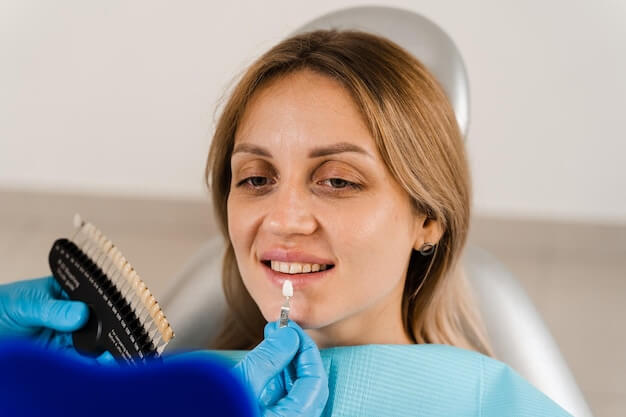
Porcelain veneer treatment is one of the most common forms of fixed restorations that completely cover the visible part of the tooth, aiming to provide both aesthetics and function. In everyday usage, the term “porcelain veneer” is sometimes used to refer to all types of crowns; however, in the clinic, porcelain restorations can be combined with different substructures. That is, there are metal-supported porcelain veneers with a metal substructure beneath the porcelain, as well as full ceramic options (such as Emax) or zirconium substructure porcelain veneers without metal. Therefore, when planning a “porcelain veneer,” the main decision is which substructure and indication porcelain will be used for.
The primary purpose of porcelain veneers is to surround and protect the tooth entirely while reconstructing the natural tooth anatomy. Veneers are used on teeth with large fillings, root canal treated teeth, or teeth at risk of cracking; the goal is to distribute chewing forces more evenly to reduce the risk of fracture. Aesthetically, they provide a more harmonious appearance on teeth with permanently discolored, deformed shape, poor symmetry, or incompatible old restorations. Particularly in the anterior region, the translucency of porcelain, surface texture, and color characterization (veins, mamelons, translucency transitions) are crucial for a natural result. In the posterior region, durability and occlusion compatibility come to the forefront.
A successful porcelain veneer is not limited to “looking beautiful”; biological compatibility and cleanability are as important as aesthetics. If the margin where the veneer meets the gum is not designed correctly, plaque accumulation can increase, leading to gum bleeding or recession. Therefore, the preparation margin is determined considering the gingival biotype (thick–thin), gingival levels, and the patient’s hygiene habits. Additionally, if the occlusal relationship is not properly adjusted, cracks, fractures, or sensitivity issues can develop on the porcelain surface. For this reason, porcelain veneer treatment is a restorative process that requires coordinated work between the dentist, patient, and laboratory.
The treatment plan typically includes examination, tooth preparation, impression taking, temporary veneer, try-in, and final cementation steps. Impressions can be taken via traditional methods or digital scanners; when laboratory fabrication is complete, a try-in is performed and, if appropriate, the veneer is permanently cemented. If multiple teeth are veneered, try-in stages are carried out more meticulously to enhance color and shape harmony. With the correct indication and proper care, porcelain veneers can be used safely for many years in terms of both aesthetics and function.
What Is Porcelain Veneer Treatment?
Porcelain veneer treatment is a fixed restoration that completely covers the outer surface of the tooth, giving it a new form, color, and durability. This restoration is called a “crown” and encircles the tooth 360 degrees. The porcelain part of the veneer is an aesthetic material that can mimic the enamel structure of the natural tooth; the color and shape can be personalized. However, the often overlooked aspect of porcelain veneers is their substructure: metal-supported porcelain crowns, zirconium-supported porcelain crowns, or full ceramic systems can exhibit different clinical characteristics.
The goals of porcelain veneers can be summarized under three main headings:
- Protection: Surrounding the weakened tooth to reduce the risk of fracture
- Function: Correcting chewing and occlusal relationships, recreating contact points
- Aesthetics: Improving color, shape, and smile harmony
Porcelain veneers provide “circumferential protection” that cannot be achieved by the filling alone, especially in teeth with large restorations. In root canal treated teeth, since the tooth structure can become fragile, reinforcement with a veneer is a commonly planned approach. Aesthetically, porcelain offers natural appearance through color stability, surface gloss, and laboratory characterization.
The success of this treatment depends on proper tooth preparation, accurate impression taking, high-quality laboratory production, and correct application of the bonding/cementation protocol.
How Is Porcelain Veneer Treatment Performed?
Porcelain veneer treatment is a process usually completed in several appointments, with each stage requiring precision. During the first appointment, an examination is conducted; the condition of tooth decay, existing restorations, gum health, and occlusion are evaluated. Radiographs are taken to check the root tip and surrounding bone tissue. If the tooth to be veneered has decay, suspected cracks, or needs root canal treatment, these issues are addressed first. Since the veneer covers the surface of the tooth, leaving underlying problems untreated can lead to long-term risks such as pain, infection, or decay beneath the veneer.
In the second stage, the tooth is prepared (tooth preparation). Under local anesthesia, a controlled amount of tooth structure is removed to accommodate the veneer. The preparation margin (the line where the veneer will end) is defined, and the tooth shape is adjusted to fit the veneer. Preparation details vary depending on the type of veneer chosen; for example, metal-supported porcelain requires different thicknesses in some areas, whereas full-ceramic veneers need a more uniform thickness for aesthetic reasons.
Next, an impression is taken. This can be done using conventional impression materials or a digital scanner. The goal of the impression is to ensure the veneer edges fit perfectly on the tooth and that contact points are accurate. After the impression, most patients receive a temporary veneer. The temporary veneer protects the tooth from sensitivity, provides aesthetics, and maintains the form of the gum tissue. During the temporary period, patients should be careful with hard and sticky foods because temporary cements have weaker retention.
When the laboratory stage is complete, a try-in appointment is scheduled. The color, shape, gum adaptation, contacts with adjacent teeth, and occlusion of the veneer are checked. Minor adjustments are made if necessary. Once approved, the veneer is cemented (bonded). After bonding, occlusion is rechecked and polishing is performed. The patient is then informed about hygiene and usage instructions, and a follow-up care plan is established.
Who Is Suitable for Porcelain Veneer Treatment?
Porcelain veneer treatment may be suitable for many patients who need structural reinforcement or aesthetic improvement of their teeth. Suitability depends on the current condition of the teeth and the patient’s oral environment. Veneers are particularly indicated in teeth with large fillings, root canal-treated teeth, teeth at risk of fracture, or cases where the tooth form is severely altered. Aesthetically, veneers are planned for teeth with permanent discoloration, incompatible shapes, or old restorations that are insufficient in appearance.
However, gum health is a fundamental criterion in assessing suitability. If active gingival inflammation, bleeding, heavy plaque, or periodontitis are present, periodontal treatment should be completed first. Because veneer margins are closely related to the gums, poor gum health may cause gum recession and aesthetic loss after veneer placement. Additionally, patients with poor hygiene habits may experience increased plaque accumulation at veneer margins, raising the risk of gum problems and decay under the veneer.
The retention of the tooth is also important. If the tooth is heavily damaged, a veneer alone may not be sufficient, and additional support treatments might be necessary. In some cases with poor prognosis, extraction and implant placement may be a better option. This decision is based on clinical examination and radiographic findings.
Patients who grind or clench their teeth (bruxism) can get porcelain veneers; however, risk management is essential. Precise occlusal adjustments, appropriate material selection, and often the use of a night guard are recommended. In summary, suitability for porcelain veneers is evaluated considering healthy gums, manageable occlusal forces, and correct indications.
What to Pay Attention to Before Porcelain Veneer Treatment
The primary consideration before porcelain veneer treatment is addressing any active problems in the oral cavity. Decay, leaking restorations, fractures, cracks, or root canal treatment needs in the tooth scheduled for veneering must be treated beforehand.
Pre-Treatment Considerations Before Porcelain Veneers
If any dental issues exist, these should be addressed first. Because a veneer covers the tooth surface, applying it without resolving underlying problems increases the risk of pain, infection, or decay beneath the veneer in the future. Gum health is equally important: if there is gum bleeding, inflammation, or significant tartar buildup, periodontal cleaning and hygiene education should be performed before veneer placement.
The second important aspect is occlusion analysis. For a veneer to last long, the occlusal contacts must be balanced. Especially in patients suspected of bruxism (characterized by tooth wear, fractures, or morning jaw fatigue), this factor must be incorporated into the treatment plan. Correctly analyzing the occlusal relationship before veneer application can significantly reduce the risk of cracks or fractures afterwards. If necessary, a night guard can be added to the treatment plan.
Preparations for aesthetic planning are also vital. Goals such as color selection, tooth shape, length, and symmetry should be clearly defined. If veneers are planned and the patient wants to lighten the overall tooth shade, the dentist may recommend whitening first, followed by selecting the veneer color. This is important because the veneer shade is fixed; if natural teeth color changes later, the match may no longer be harmonious.
Preparation for the provisional veneer phase is also practical. Veneer treatment usually requires at least two appointments; during this time, provisional veneers are used. Since provisional veneers are more delicate, patients should avoid hard or sticky foods. Additionally, maintaining good oral hygiene on appointment days helps keep the gingival tissue stable and fitting properly around impressions. When these steps are properly managed before veneer placement, both aesthetic outcome and biological compatibility improve.
What to Pay Attention to After Porcelain Veneer Treatment
Post-treatment care is critical for extending the lifespan of veneers and maintaining gum health. Mild sensitivity may be experienced in the first few days, especially to hot or cold stimuli or brief discomfort during chewing. This usually decreases with adaptation. However, if a sensation of high occlusion, significant discomfort while chewing, or jaw fatigue occurs, the patient should not delay a follow-up. High occlusion puts excessive stress on the veneer and increases the risk of cracks.
Dietary habits strongly influence the durability of porcelain veneers. Activities such as chewing ice, cracking nuts with teeth, or applying excessive force to hard foods at one spot can cause micro-cracks in the porcelain. Veneers are durable; however, the risk of porcelain fracture is not zero. Therefore, it is important not to use the veneered tooth like a tool just because a veneer is present.
Oral hygiene is essential to keeping veneer margins healthy. The veneer covers the tooth, but plaque tends to accumulate at the margins where the veneer meets the gum line. Hence, brushing at least twice daily and using dental floss or interdental brushes are necessary. This interdental cleaning becomes especially important if multiple veneers are present. Poor hygiene increases the risks of gum bleeding, recession, and long-term leakage at the veneer margins.
For patients with bruxism, the use of a night guard is often a critical protective measure. Grinding and clenching apply different and more intense forces to veneers beyond normal chewing forces, raising the risk of cracks or fractures in the porcelain. Regular dental check-ups monitor occlusal balance, gum health, and the integrity of veneer margins. With proper care and appropriate habits, porcelain veneers can provide trouble-free function for many years.
Indications for Porcelain Veneer Treatment
Porcelain veneer treatment is applied when a tooth requires restoration both aesthetically and structurally. One of the most common indications is teeth with large fillings. If the filling covers most of the tooth and the remaining tooth structure is weak, the tooth becomes prone to fracture. In such cases, a porcelain veneer that covers the tooth circumferentially can provide a more balanced distribution of forces.
Teeth that have undergone root canal treatment are also frequent candidates for porcelain veneers. After root canal therapy, the tooth structure is more fragile and…
Reasons for Porcelain Veneer Treatment
Porcelain veneer treatment is performed to protect the tooth, improve chewing function, and enhance aesthetic appearance. Protective purpose is especially prominent in structurally weakened teeth. Teeth with large fillings or root canal treatments have a higher tendency to fracture the remaining natural tooth structure. Porcelain veneers surround the tooth completely, enabling a more balanced distribution of forces and aiming to reduce the risk of fracture. This approach may contribute to keeping the tooth healthy for a longer time in the oral cavity.
Functionally, porcelain veneers help restore the anatomical form of the tooth and regulate occlusal contacts. When the tooth form is compromised, contact with adjacent teeth may be lost, leading to food impaction, which in turn causes gum problems. Veneers recreate the contact points, properly restore the chewing surface anatomy, and help stabilize the chewing function. Additionally, in worn teeth, veneers can adjust tooth length to improve both function and aesthetics.
Esthetic aims are among the most well-known reasons for porcelain veneer treatment. In teeth that are discolored, misshapen, or negatively affecting the smile aesthetics, porcelain veneers aim to provide a more symmetrical and natural appearance. Due to the color stability and laboratory characterization of porcelain, results close to natural dental tissue can be achieved. However, for lasting esthetic success, maintaining gingival health and precise margin adaptation of the veneer are essential.
Moreover, renewal of old restorations is also a reason for applying porcelain veneers. Over time, issues such as marginal leakage, discoloration, porcelain fractures, or gingival problems can arise in old veneers. Renewal can improve both biological compatibility and aesthetic quality. In summary, porcelain veneers, when indicated correctly, offer a comprehensive solution that is protective, functional, and aesthetic.
Duration of Porcelain Veneer Treatment
The duration of porcelain veneer treatment varies depending on the number of teeth to be veneered, the complexity of tooth preparation, the impression method (digital or conventional), laboratory fabrication time, and additional treatments if needed. For a single tooth, the process can often be completed in 2–3 appointments. During the first visit, the tooth is prepared and impressions are taken; a temporary veneer is placed. At the second visit, try-in and bonding are planned; in some cases, the try-in might be scheduled as a separate appointment.
When multiple teeth are treated, especially in the anterior region, try-in procedures for esthetic harmony are more detailed. Additional appointments may be necessary for color matching, form symmetry, alignment with the smile line, and to meet patient expectations. Although this can lengthen the treatment duration, it enhances the esthetic quality. Furthermore, if gingival contouring is required, allowing adequate healing time for the gums is essential.
Waiting Time and Treatment Schedule
Waiting time may be added to the treatment schedule. Laboratory time also affects the overall timeline. The production of porcelain veneers includes infrastructure preparation, layering/processing of porcelain, firing, glazing, and polishing. These steps require time to ensure a high-quality result. Digital manufacturing techniques can accelerate the process in some cases; however, this does not necessarily mean that veneers can be completed the same day for every case.
Additional treatments can significantly alter the duration: such as cavity treatments, root canal therapy, periodontal treatments, or a night guard plan for bruxism. The most accurate duration information becomes clear once a personalized treatment plan is created after examination.
Porcelain Veneer Treatment Prices
Porcelain veneer treatment prices vary depending on the number of veneers to be placed, the type of underlying material chosen (metal-supported porcelain, zirconia-based porcelain, full ceramic systems, etc.), the level of laboratory craftsmanship (characterization, color gradients, surface texture), the impression method (digital/classical), the current condition of the tooth (removal of old veneers, need for fillings/root canal treatment), and any additional necessary procedures. Therefore, stating a single price under the title “porcelain veneer” is often not accurate; the treatment plan is personalized for each individual.
For example, a single veneer on a posterior tooth is quite different in scope compared to a treatment plan covering multiple anterior teeth with an emphasis on aesthetics. Some patients may require additional steps prior to veneer placement such as periodontal treatment, whitening, or provisional veneers to guide the gum contour. These steps enhance the quality and longevity of the treatment and simultaneously influence the cost plan.
For up-to-date and personalized information about porcelain veneer treatment prices, please contact us. After your examination, we will transparently share which type of veneer is more appropriate for you, how many teeth will be treated, and how the associated costs are structured.