
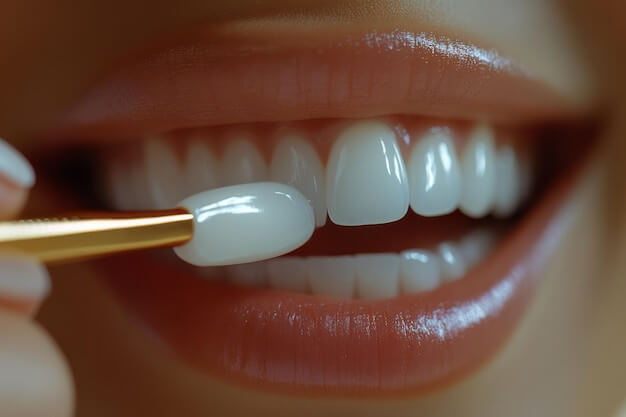
Composite veneer is the application of composite resin material on the outer surface of anterior teeth to improve their appearance for aesthetic purposes. The application is planned with goals such as whitening the tooth color, correcting the shape, balancing the tooth length, closing small gaps, and aesthetically masking minor alignment issues. In most cases, minimal tooth tissue reduction is performed; in some cases, only surface roughening is sufficient. This characteristic makes composite veneers a conservative aesthetic option.
The determinants of success in composite veneers are quality isolation (moisture control), proper adhesive protocol, layering technique, and polishing. The composite material can be applied in layers with different opacities and shades to mimic the natural appearance of the tooth. When translucency of the incisal edges, surface gloss, and natural tooth light reflection are correctly created, the “filling-like” appearance is significantly reduced. Achieving a smooth and glossy surface after the application reduces stain accumulation, lowers plaque build-up at the gingival margin, and helps maintain the aesthetic appearance for a long period.
Composite may be more prone to surface staining compared to porcelain. Regular consumption of tea or coffee, smoking, and inadequate oral hygiene can cause composite surfaces to become dull and discolored over time. This condition can often be managed by professional cleaning and polishing. The ability to repair small edge chippings or wear is one of the practical advantages of composite veneers.
The risk increases in cases of teeth grinding or clenching (bruxism). In such patients, occlusal contacts are carefully adjusted, point loading on anterior teeth is avoided, and the use of a night guard is considered. If there is periodontal disease, active decay, or leaking restorations, these must be treated before aesthetic application; otherwise, marginal fit and long-term gingival health may be adversely affected.
What Is Composite Veneer?
Composite veneer is an aesthetic restoration created by reshaping the outer surface of the tooth using composite resin. Composite is a light-curing material available in various shades and opacities that can be layered to resemble the natural tooth structure. In veneer application, composite is applied not as a single bulk mass for “color masking” but in layers to achieve a more natural outcome. Features such as dentin effect, enamel effect, and incisal edge translucency can be created with the correct technique.
Composite veneers can be produced in two main ways. Direct composite veneer is applied directly to the tooth in the clinic during the same appointment. Indirect composite veneer is fabricated in the laboratory and then bonded to the tooth afterwards. The direct technique provides rapid results and allows same-day corrections if needed. The indirect technique may be planned for certain cases aiming for more controlled anatomical form and surface quality. The choice of method depends on the condition of the teeth, desired aesthetic details, and the clinician’s approach.
Composite veneer is frequently preferred in aesthetic plans focusing on preserving tooth structure. However, it is not suitable for every case; severe crowding, major occlusal problems, or teeth requiring extensive restorations may be better treated with alternative options.
How Is Composite Veneer Applied?
Composite veneer application begins with examination. Gingival health, presence of decay, marginal adaptation of existing fillings, tooth color, and occlusal relationship are evaluated. If necessary, photographs and impressions/digital scans are recorded. If there is calculus build-up or gingival bleeding, professional cleaning and periodontal therapy are planned first. Shade selection is made by assessing the difference between the patient’s target tone and the current tooth color.
On the day of application, the tooth surface is cleaned. Minimal contouring or very limited enamel reduction can be performed if the case requires. Then isolation is established. If moisture control is insufficient, bond strength may decrease and marginal leakage risk increases; therefore, the isolation step is considered critical. The enamel/dentin surface is appropriately etched…
Composite Material Application and Finishing
The bonding system is applied and light-cured. The composite material is applied in layers according to the planned shape. The width, length, contact points, and gingival margin transition of the tooth are shaped by the practitioner. The incisal edge line, surface micro-texture, and gloss level significantly influence the aesthetic result. Each layer is polymerized. At the finishing stage, contours are refined, contacts and interface transitions are checked, and occlusion is adjusted. The final step involves high-gloss polishing; reducing surface roughness decreases stain accumulation.
Who is Suitable for Composite Veneers?
Composite veneers are commonly used for patients with small gaps in the anterior teeth, broken or worn edges, shape irregularities, minor size differences, and mild crowding requiring aesthetic correction. They can be a suitable option for those who want to preserve tooth tissue, desire quick results, and have regular maintenance habits. Patients with poor oral hygiene, ongoing gingival bleeding, or heavy plaque accumulation should first undergo hygiene and periodontal stabilization; otherwise, discoloration at restoration margins and gingival problems may occur more frequently.
Composite veneers can be performed in cases of bruxism; distribution of masticatory forces and anterior contacts are adjusted more carefully. Night guards are a commonly used approach to extend the lifespan of restorations. In cases of severe crowding or significant occlusal problems, composite camouflage may make teeth appear excessively bulky and complicate hygiene; in such cases, orthodontic or porcelain options are considered.
Precautions Before Composite Veneers
Before composite veneer application, caries, leaking fillings, cracked tooth suspicion, causes of sensitivity, and gingival health should be evaluated. Initiating aesthetic treatment without performing tartar removal and necessary periodontal procedures can cause bleeding and swelling at the gingival margin, complicating the working area; margin adaptation and polished surface quality may be negatively affected. If active caries or leakage is present in the teeth to be treated, restorative treatment should first restore healthy tissue.
The color target should be clarified. If whitening is considered, it is more appropriate to plan whitening before selecting the composite shade, as composite does not lighten with whitening and color mismatch may appear later. If tooth lengthening is planned, phonetic effects should be evaluated; temporary adaptation may be needed for S, F, and V sounds. Therefore, in some cases, seeing the tooth length and form decision intraorally using a mock-up trial is beneficial.
If there is suspicion of bruxism, temporomandibular joint complaints, night clenching, or morning jaw fatigue, these should be communicated before the procedure. Occlusion planning, composite design, and the need for a protective night guard are determined more accurately with this information.
Postoperative Care for Composite Veneers
After composite veneers, regular oral hygiene is necessary to maintain surface gloss and reduce plaque accumulation at margin areas. Brushing at least twice daily and daily interdental cleaning (dental floss/interdental brushes) should be performed. Highly abrasive toothpastes can dull the composite surface over time; it is safer to continue with products recommended by the dentist.
If drinks and foods prone to staining are consumed regularly, superficial stains may appear on composite surfaces over time. These stains can often be reduced with professional polishing. Scheduling regular check-ups and polishing appointments reduces surface roughness, decreases stain retention, and refreshes the aesthetic appearance.
Habits such as breaking hard shelled foods with anterior teeth, biting pencils, or nail biting increase the risk of margin chipping. For patients with bruxism, night guard use particularly helps protect restorations on anterior teeth. If there is a sensation of “early contact on a single tooth,” pressure at a single point while chewing, or discomfort during occlusion, timely control should not be delayed.
Composite Veneer Treatment
Composite veneers are applied for repairing small cracks, reshaping worn incisal edges, creating a more balanced anterior tooth form, and aesthetically correcting minor crowding. They provide a quick aesthetic improvement for conical lateral incisors, short appearing teeth, and small surface shape irregularities.
They can also be used when color uniformity is compromised; however, in cases of very dark discoloration, more opaque composite layers may be required for masking. This can make managing the tooth’s natural translucency challenging. In such cases, porcelain laminates may be a more suitable option. If the tooth positioning is significantly irregular, orthodontic correction may be a more conservative choice instead of camouflage with composite.
Why Choose Composite Veneers?
Composite veneers are done to conserve tooth structure while achieving aesthetic improvements, enhance dental symmetry and smile line balance, restore chipped or worn edges, and correct minor aesthetic defects in the anterior region in a single session. The minimal tooth reduction required makes it a preferred choice for many patients. The ability to perform minor same-day touch-ups accelerates reaching the aesthetic goal.
The reparability of composite is another key factor. When small edge wear or localized fractures develop over time, most cases can be corrected with additional composite and polishing. This is considered a practical advantage compared to porcelain restorations. For some patients, composite veneers can be planned as a controlled adaptation phase before smile design procedures, which helps in acclimating to changes in tooth length and form.
Proper occlusal adjustment is especially important for functional comfort. Restoring worn incisal edges can improve speech and chewing comfort for some patients. These goals should be planned with evaluation of the temporomandibular joint and muscles.
How Long Does Composite Veneer Treatment Take?
Direct composite veneers can be completed in most cases within the same day. The duration depends on the number of teeth treated, layering details, and clinical time needed to establish symmetry. Minor corrections on a few teeth may require less time. More extensive aesthetic designs covering 6–8 anterior teeth involve meticulous impression taking, mock-up, layering, and polishing, thus prolonging appointment times and possibly requiring two visits.
If indirect composite veneers are planned, the process includes impression/digital scanning, laboratory fabrication, and bonding stages, needing several appointments. If whitening, periodontal treatment, or caries management is necessary, the total duration is adjusted according to their schedules.
The longevity of composite veneers is closely related to factors such as bruxism presence, dietary habits, oral hygiene, and regular polishing. Surface gloss and margin integrity are evaluated during follow-ups, and polishing or minor repairs are performed as needed.
Composite Veneer Prices
Composite veneer costs vary depending on the number of teeth treated, whether direct or indirect technique is used, the composite material’s category, aesthetic craftsmanship details (layering and characterization), isolation methods, and any necessary pre-treatment procedures. If scaling, caries treatment, restoration replacement, or periodontal therapy is needed, the overall plan is arranged accordingly. Protective appliances such as night guards may be included in the plan for patients with bruxism.
For current and personalized pricing information, please contact us. After examination, when the number of teeth, technical approach, and additional needed procedures are determined, a transparent cost plan will be provided.