
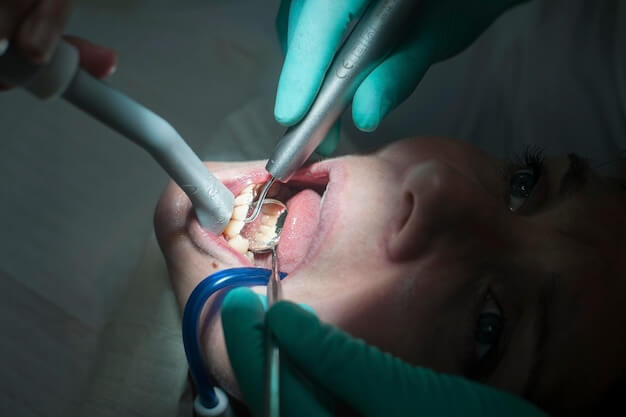
Endodontic surgery is a general term for advanced endodontic procedures performed to surgically clean infections and inflamed tissues at the root apex of a tooth that has undergone (or is planned for) root canal treatment and to seal the root apex hermetically. The most commonly performed endodontic surgery is apical resection (apicoectomy) accompanied by retrograde filling. The aim is to preserve the tooth in the mouth without extraction, eliminate chronic infection at the root apex, and support bone healing. In some cases, classical (orthograde) treatment performed through the canal is sufficient, while in others, problems in the root apex area cannot be resolved without surgical intervention.
Persistent lesions at the root apex (dark areas seen on X-rays), recurrent abscesses, pain when biting, or occasional swelling may indicate the need for endodontic surgery. This condition can be related to root canal treatment failure, but it may also arise due to root fractures, lateral canal infections, anatomical variations at the root apex, incomplete cleaning of the canal, inadequate root canal filling, or foreign bodies near the root apex. Often, retreatment of the root canal is the first choice if possible; however, endodontic surgery becomes a more rational option when removing bridges/crowns on the tooth is very difficult, access to the canal is limited, or retreatment from inside the canal is unpredictable.
Imaging is important in planning endodontic surgery. Panoramic or periapical radiographs are used to assess the location and size of the lesion; if the lesion is close to critical anatomical structures such as the sinus (in the posterior maxilla), mandibular canal, or mental foramen (in the mandible), three-dimensional imaging (CBCT) may be requested. CBCT helps better evaluate the lesion’s boundaries within the bone, the position of the root apex, cortical bone thickness, and any suspicion of root fracture. This allows the surgical approach to be planned more safely and predictably.
The procedure is usually performed under local anesthesia. The surgeon lifts a gingival flap in the relevant area, opens a small window in the bone to reach the lesion, cleans the inflamed tissue, and resects a certain portion of the root apex (usually a few millimeters according to most protocols). Then, a retrograde cavity is prepared in the root apex and sealed with a biocompatible material to prevent leakage. The area is cleaned and closed with sutures. Swelling and sensitivity may occur during the healing process; these are generally more pronounced in the first 48–72 hours and gradually decrease thereafter. Sutures can usually be removed within 5–10 days, depending on the type of suture used. Bone healing continues over months and is monitored with radiographic check-ups.
What Is Endodontic Surgery?
Endodontic surgery is the surgical management of problems related to the root canal system. Classical root canal treatment aims to clean and fill the infection from inside the canal. However, in some cases, the infection persists around the root apex or in anatomical regions unreachable from within the canal (such as lateral canals or the apical delta), serving as a microbial reservoir. Endodontic surgery intervenes at this point: the inflamed tissue at the root apex is directly visualized and cleaned, and the root apex area is sealed hermetically to prevent bacterial reinfiltration.
The best-known application is the combination of apical resection (apicoectomy) and retrograde filling. In apicoectomy, the infected portion of the root apex is removed; retrograde filling seals the root canal from the root apex side. In some cases, only lesion curettage (cleaning of inflamed tissue) and/or root apex biopsy may be performed. The tissue removed during surgery can be sent for pathological examination, which is especially important when the lesion’s nature is uncertain.
Endodontic surgery can be considered a “final conservative step” instead of tooth extraction; however, when performed with correct indication, success rates are high. Success depends on correct case selection, surgical technique, and quality of the retrograde filling material.
How Is Endodontic Surgery Performed?
The procedure begins with a clinical examination and imaging. The tooth’s symptoms (pain upon biting, swelling, presence of fistula), periodontal probe depths, tooth mobility, and the integrity of restorations are assessed. The location and size of the lesion are examined with periapical radiography; in cases of anatomical risks or complex situations, three-dimensional planning with CBCT is performed. At this stage, it is also evaluated whether retreatment of the root canal therapy is possible, as in some cases retreatment may be a more appropriate first option than surgery.
On the day of the procedure, local anesthesia is usually administered. The surgical area is prepared antiseptically. A flap is designed over the gingiva in the related region, and the tissue is gently reflected. A small window (osteotomy) is created in the bone to access the root apex. The lesion tissue (granulation tissue/cyst-like structure) is removed and sent for pathology if necessary. Then a specific portion of the root apex is resected. Modern protocols aim for a flat and controlled root-end cut to better manage multiple canal exits at the apex.
The next step is retrograde cavity preparation. A small cavity is prepared from the root apex toward the apical part of the canal filling. This cavity is filled with a biocompatible, highly sealed material (retrograde filling). The goal is to prevent bacteria inside the canal from leaking through the root apex into surrounding tissues. The area is irrigated with serum, bleeding is controlled, and the flap is repositioned and sutured.
A postoperative care plan is provided: cold application for swelling management during the first 24–48 hours (according to the doctor’s recommendation), soft diet, oral hygiene protocol, prescribed medications, and a control appointment. Sutures can usually be removed within 5–10 days in most cases. Bone healing takes longer; although clinical symptoms may rapidly decrease, radiographic healing is monitored gradually over 6–12 months.
Who Is Suitable for Endodontic Surgery?
An appropriate candidate for endodontic surgery is a patient whose tooth can be retained in the mouth restoratively and periodontally but who has a problem at the root apex area that prevents success with conventional root canal treatment (or where success is not foreseeable). Endodontic surgery may be considered if a root apex lesion persists radiographically after root canal treatment and clinical symptoms (pain on biting, recurrent swelling, fistula) continue. Surgery may also be a more suitable option when retreatment is technically difficult (e.g., severely limited access without removing a bridge/crown, presence of broken instruments in the canal, or post-core restorations).
Periodontal support of the tooth is important in suitability assessment. Prognosis worsens with advanced bone loss, severe mobility, or suspicion of root cracks. Vertical root fractures, in particular, significantly reduce the success rate of endodontic surgery; therefore, suspicion of cracks must be carefully analyzed with CBCT and clinical findings. If the tooth’s coronal restoration is leaking, restorative sealing must be established before or together with surgery; otherwise, the risk of reinfection increases.
General health status is also considered. Planning is necessary for bleeding management in patients using blood thinners. Uncontrolled diabetes, immunosuppression, and similar conditions may affect healing; these patients require closer follow-up. Smoking is discouraged or advised to be reduced because it can negatively impact wound healing. A suitable candidate is someone who can comply with postoperative care instructions, attend control appointments, and maintain oral hygiene.
What Should Be Considered Before Endodontic Surgery?
The most critical step before surgery is accurate diagnosis and indication. It is essential to confirm that the lesion in the tooth is of endodontic origin; periodontal lesions, cracks, or restorative problems can cause similar symptoms. Clinical tests and periodontal assessment should be performed thoroughly.
Evaluation and Treatment Planning
Assessment is performed using examinations, radiographs, and if necessary, CBCT scans. The decision whether surgery or retreatment is more appropriate is made considering the tooth’s restorative conditions.
A complete medical history must be shared. Blood thinners, aspirin-like medications, diabetes, hypertension, allergies, and all medications used should be reported. The dentist coordinates with the relevant physician if necessary to plan bleeding management and medication schedules. It is important to arrange a comfortable schedule for the day of the procedure; especially more rest may be required in the first 24–48 hours postsurgery.
Oral hygiene should be optimized before surgery. High plaque levels can adversely affect wound healing. If the patient smokes, abstinence before and after surgery supports recovery. In cases of acute infection flare-ups, infection control may be prioritized before planning surgery; this decision depends on swelling, pain, and systemic symptoms.
The patient’s expectations must be clarified. Endodontic surgery increases the chance of preserving the tooth in the mouth; however, success cannot be guaranteed in every case. The lesion size, root anatomy, quality of restorative seal, and biological response influence the prognosis. It should be explained that radiographic healing after surgery will occur over months, while clinical relief may begin earlier.
Post-Endodontic Surgery Care
In the postoperative period, managing swelling and sensitivity while protecting the wound area is a priority. Cold applications can be used according to the dentist’s recommendations in the first 24–48 hours; this helps reduce edema. Prescribed pain medications should be taken regularly. Bleeding is usually mild and appears as slight oozing; however, continuous fresh bleeding may indicate unstable clot formation and requires attention. Avoid strenuous exercise and activities that may increase bleeding such as hot baths or saunas during the initial days.
Nutrition should consist of soft and warm foods. Very hot, spicy, or hard foods can irritate the suture area. Oral hygiene must be maintained carefully without directly traumatizing the surgical site when brushing. If the dentist recommends antiseptic mouth rinses, they should be used at the recommended frequency and duration; very strong rinsing early on may dislodge the clot. Since smoking impairs healing, especially during the initial days, cessation or reduction is critical.
If sutures are present, avoid manipulating them. Suture removal is usually planned within 5 to 10 days depending on the type of suture used. Swelling is generally most noticeable on days 2–3 and gradually subsides. Bruising may appear in some patients. Immediate follow-up is required if any of the following occur: increasing pain, bad odor or taste, fever, rapidly increasing swelling, difficulty swallowing or breathing, numbness.
Long-term monitoring of root tip healing is performed radiographically. Radiographic healing progresses gradually over 6–12 months even if clinical symptoms have resolved. The dentist schedules follow-up appointments according to the initial lesion size.
Indications for Endodontic Surgery
Endodontic surgery is performed when apical infection persists despite root canal treatment or when retreatment is not predictable. The most typical scenario is a persistent apical lesion and symptoms in a root canal treated tooth. Signs such as gum fistula formation, recurrent abscesses, pain on biting, or enlargement of the lesion on radiographs may indicate surgery.
Conditions that complicate nonsurgical retreatment also favor surgery: fractured instruments within the canal, difficult-to-remove post-core systems, bridge abutment teeth with restorations that risk detachment, and anatomical obstructions to canal access. In these cases, surgery allows intervention at the root apex without damaging the coronal restoration. Additionally, if apical anatomical variations (apical delta, lateral canals) prevent adequate canal disinfection, surgery permits direct cleaning.
In some cases, benign cyst-like lesions in the apical region may be suspected; these are surgically removed and sent for pathology during the procedure.
Why Is Endodontic Surgery Performed?
Endodontic surgery is performed to preserve the tooth without extraction and to eliminate the chronic infection focus around the root apex. Root canal therapy manages infection within the canal; however, in some cases, bacteria may persist in the complex anatomy near the root apex, or microleakage may occur in the canal filling. This leads to persistent inflammation at the root tip. Surgery aims to reduce the risk of reinfection by directly removing the infected tissue and sealing the root tip with a retrograde filling.
Keeping the tooth in the mouth is valuable for both function and biology. Alternatives such as implants or bridges come into consideration after extraction; these options have their own unique procedures and risks. Endodontic surgery offers a chance to preserve the natural tooth in appropriate cases. Additionally, recurrent abscesses and swellings can impact the patient’s daily life; surgery can control the source of these attacks.
The decision to proceed with surgery is not always a “last resort”; in some cases, surgery may be more rational than retreatment. For example, if removing a restoration poses a high risk of damaging the tooth, surgical access may offer a more predictable outcome. The primary goal is to achieve the highest long-term stability with minimal tissue loss.
How Long Does Endodontic Surgery Take?
The duration of the procedure varies depending on the tooth’s location, the number of roots, the size of the lesion, bone thickness, anatomical neighbors, and any additional procedures performed during the same session. Access may be easier on a single-rooted anterior tooth, while reaching root apices in multi-rooted molars can be more complex. Nearness to the sinus in the upper jaw or nerve proximity in the lower jaw requires more careful planning and may affect the surgery duration.
The total time spent in the clinic includes anesthesia, preparation, postoperative bleeding control, and patient instructions. Suture removal is generally planned within 5–10 days. Swelling and tenderness are most pronounced during the first 2–3 days in most cases, then progressively decrease. Bone healing is a longer process monitored by radiographs, with follow-up appointments often planned within 6–12 months. The treating dentist personalizes the follow-up schedule according to the initial condition of the lesion.
Endodontic Surgery Costs
Prices vary depending on the scope of the surgical procedure (apical resection, retrograde filling, lesion excision/biopsy), the tooth’s location and number of roots, lesion size, necessary imaging methods (X-ray, CBCT if needed), surgical consumables, suture requirements, anesthesia choice, and postoperative control plan. The status of previous root canal treatment, the type of tooth restoration (crown, bridge abutment, presence of post), and anatomical risks also influence the treatment plan.
For up-to-date and personalized information about endodontic surgery costs, please contact us. After examination and imaging, a tailored treatment plan will be prepared, and cost details related to the scope and follow-up plan will be transparently communicated.