
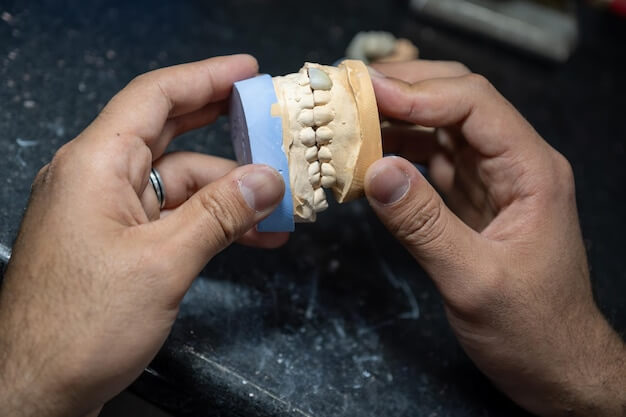
Implant-supported prosthesis is a treatment approach where the prosthesis replacing missing teeth is stabilized by dental implants placed into the jawbone. One of the biggest issues with conventional complete dentures is the movement of the denture, especially in the lower jaw, causing displacement during speaking and eating, irritation sores, and consequent loss of confidence. Implant-supported prostheses provide an important advantage at this point: retention and stability of the prosthesis increase, chewing efficiency improves, and the patient’s daily comfort is noticeably enhanced.
This treatment mainly appears in two forms. The first is the “removable implant overdenture” approach: the denture locks into place with attachment components fixed to the implants; the patient can remove and clean the denture. The second is the “fixed implant-supported prosthesis” approach: the prosthesis cannot be removed by the patient; the dentist can remove and reattach it for periodic check-ups and maintenance. The choice of approach depends on bone volume, number of implants, lip support requirements, oral hygiene capability, parafunctional habits (bruxism) risk, and the patient’s expectations.
The most critical element in implant-supported prosthesis planning is achieving biological and mechanical balance simultaneously. Although implants resemble “screws,” they are biological structures that integrate with bone (osseointegration), and to maintain this integration healthily, proper surgical planning, correct prosthesis design, and regular maintenance are required. Load distribution, occlusal balance, and cleaning access are always considered in prosthesis design. Otherwise, complications such as peri-implant mucositis/peri-implantitis, screw loosening, or prosthesis fractures may occur around the implant.
The process usually begins with examination and imaging. Panoramic radiographs and, in most cases, three-dimensional imaging (CBCT) are used to assess bone volume and the position of anatomical structures. Digital scanning or impressions are taken; occlusion and vertical dimension are planned; if necessary, the patient’s function and aesthetics are tested with a provisional prosthesis. After implant surgery, a healing period for bone regeneration may be needed; although “immediate loading” protocols might be suitable in some cases, implant stability and bone conditions are decisive factors. The prosthetic phase is completed with soft tissue shaping and impression-fitting steps. Regular follow-ups and professional maintenance are fundamental for the long-term success of the treatment.
What Is an Implant-Supported Prosthesis?
An implant-supported prosthesis is a denture treatment supported by implants to compensate for tooth loss, aiming to increase prosthesis retention and chewing function. In edentulism, jawbone may resorb over time, reducing the denture’s seating area. This especially causes the lower denture to move, produce irritation sores, and lead to insecurity during eating and drinking. Implants provide “anchorage” points to the prosthesis, reducing movement and helping the prosthesis to stay more stable.
In removable implant overdentures, typically several implants are placed with an attachment system; the prosthesis fits and locks onto these attachments. The patient can remove and clean it, which offers a manageable hygiene solution for many. Fixed implant-supported prostheses may require more implants and a different framework design; the prosthesis is designed to be removable only by the dentist. The fixed approach may be advantageous for patients seeking a “near-natural feel,” but hygiene protocol must be more meticulously maintained.
This treatment is not merely “placing implants and fitting a denture.” Occlusal balance, vertical dimension, lip support, speech functions, and the prosthesis’s contribution to facial aesthetics are planned together. Especially for patients who have been edentulous for a long time, vertical dimension loss can cause collapse of the lower third of the face and reduce lip support. The prosthesis design aims to restore this support while considering the temporomandibular joint and muscle adaptation.
How Is It Actually Applied?
The procedure begins with a detailed examination and planning. In the initial step, intraoral tissues, existing prosthesis (if any), occlusion, and the condition of gums and bone are evaluated. During the imaging phase, panoramic radiographs and, in most cases, CBCT scans are used to examine anatomical details such as bone volume, sinus floor, and the location of the nerve canal in the lower jaw. Based on these data, the number and placement plan of implants are prepared. Since the angle and position of implants directly affect the prosthesis design, surgical and prosthetic planning should be conducted together.
In the surgical phase, implants are placed under local anesthesia; sedation options may also be considered for some patients. After implant placement, a healing period for osseointegration is planned. Although this duration varies depending on the individual and bone quality, the primary goal is the secure integration of the implant with the bone. During this period, if the patient has an existing prosthesis, it may need adjustment to avoid excessive pressure on the implant area. Comfort can be provided in some cases with temporary prostheses or soft liners.
The prosthetic phase includes soft tissue shaping (healing abutment), impression taking/digital scanning, vertical dimension and occlusion recordings, trial appointments, and the delivery of the final prosthesis. If an overdenture is planned, the attachment system is selected, and suitable sockets are prepared inside the prosthesis. If a fixed prosthesis is planned, the framework (bar/multi-unit) and superstructure design are completed; passive fit and screw torque values are checked. Follow-up within 1–2 weeks after delivery is beneficial for adjusting pressure points, evaluating bite balance, and oral hygiene. Regular maintenance appointments (usually every six months) are essential for the sustainability of the treatment.
Who Is Suitable for Implant-Supported Prostheses?
Implant-supported prostheses are a strong option for individuals with single or multiple missing teeth, especially those who experience stability problems with removable prostheses. In edentulous cases, retention of lower jaw prostheses is among the most challenging issues; an overdenture plan with a few implants can significantly improve comfort for these patients. Similar plans can be made for the upper jaw by evaluating bone volume and sinus relationships.
The following factors are important in suitability assessment:
- General health status (diabetes control, immune system, conditions affecting bone metabolism)
- Smoking habits (may affect healing and peri-implant tissue health)
- Bone volume and quality (additional procedures such as grafting/sinus lifting if necessary)
- Oral hygiene capability and motivation (peri-implant care is critical)
- Presence of bruxism/parafunction (requires load control and prosthesis design)
- Lip support and aesthetic expectations (affects choice between removable and fixed prostheses)
In some patients, bone volume may be insufficient; in such cases, bone grafts, sinus lifting, or alternative implant protocols can be considered. Implant planning is possible for individuals with systemic diseases after appropriate consultations and risk management; however, the decision must be made through individualized evaluation.
What Should Be Considered Before Implant-Supported Prostheses?
Improving oral hygiene and eliminating existing infection foci before treatment are important. Active periodontal disease, infected roots requiring extraction, or intraoral ulcers should be managed before implant surgery. This is because the health of peri-implant tissues plays a decisive role in the long-term success of implants.
A complete medical history must be shared. Blood thinners, diabetes medications, drugs affecting bone metabolism, and allergies should be reported without omission. If the patient is a smoker, aiming to reduce or quit smoking supports healing. Additionally, in patients with nighttime teeth grinding habits, the prosthesis plan and protective measures (night guard or occlusal adjustments) should be discussed in advance.
Expectations regarding prosthesis planning should be clarified. The patient should evaluate the answer to the question “fixed or removable?” along with the advantages, disadvantages, and maintenance requirements. Cleaning is generally more practical with removable overdentures. It may be known that fixed prostheses can offer a more natural feel, but interface cleaning requires more discipline. Additionally, for individuals with a high need for lip support, removable prostheses can sometimes be more advantageous aesthetically. Such decisions can be made more safely with trial and mock-up stages.
What to Pay Attention to After Implant-Supported Prosthesis
Adhering to the dentist’s recommendations in the first days after implant surgery is critically important. Swelling and sensitivity can be expected to some extent; comfort can be increased with cold applications and medication protocols. It is necessary to avoid traumatizing the surgical area, steer clear of very hot and hard foods in the early days, and maintain oral hygiene as advised by the dentist. If there are stitches, they are evaluated and, if necessary, removed during the follow-up appointment.
The most important issue to pay attention to after prosthesis delivery is cleaning and regular check-ups. Patients wearing overdentures should remove and clean the prosthesis daily; they must clean around the attachments, the gingival margin around the implants, and the underside of the prosthesis with appropriate brushes. In fixed prostheses, hygiene around the implants should be maintained using auxiliary tools such as interdental brushes, super floss, or water jets. Insufficient cleaning can lead to bleeding and inflammation (mucositis) around the implant initially, which, if left uncontrolled, may progress to more serious problems.
Bite balance is also important. A high contact point on the prosthesis can exert excessive load on the implants. If there are bruises or discomfort while chewing within the first week after delivery, early adjustments should be made. A protective night guard may be recommended in cases of bruxism. Regular check-ups (usually every six months) that include professional cleaning, screw torque checks, and assessment of prosthetic components extend the longevity of the treatment.
When Is Implant-Supported Prosthesis Applied?
Implant-supported prostheses are often preferred in the following situations:
- Complete edentulism (especially in the lower jaw) where conventional dentures are unstable and lack retention
- Multiple missing teeth, requiring more stable and comfortable prostheses
- Existing prostheses that constantly cause sore spots and reduce chewing efficiency
- Loss of support in the lower facial region due to edentulism, causing aesthetic problems
- Cases with advanced bone resorption where stability is difficult to achieve with conventional prostheses (with appropriate implant planning)
- Situations where fixed teeth are desired but there are no natural teeth to support bridges (case-based)
The number of implants and the type of prosthesis vary case by case. In some patients, overdentures supported by a few implants suffice, while others may require more comprehensive fixed rehabilitations. The choice is made according to anatomy and patient expectations.
Why Is Implant-Supported Prosthesis Performed?
Implant-supported prostheses are performed to reduce prosthesis movement, increase chewing function, minimize problems such as prosthesis displacement during speech, and improve the patient’s quality of life. Conventional dentures lose retention as jawbone resorbs and dependence on adhesives increases. Implant support mechanically resolves this issue, providing a more secure “hold” for the prosthesis.
Besides functional benefits, psychological and social benefits are also significant. Prosthesis instability can cause people to avoid laughing or eating in social environments. A stable prosthesis can increase self-confidence. Moreover, better chewing improves nutritional quality, indirectly contributing to overall health.
Biologically, implants have the potential to make loading inside the bone more physiological and slow down bone loss; however, this effect should be evaluated with proper planning and regular maintenance. The most fundamental goal is to provide a sustainable solution that preserves both tissue health and prosthesis function in the long term.
How Long Does Implant-Supported Prosthesis Take?
The treatment duration varies according to the total of implant surgery, healing period, and prosthesis fabrication stages. The process generally includes the following steps: examination and imaging, surgical planning, implant placement, osseointegration period, impression and try-in stages for the prosthesis, and delivery. The required time for osseointegration is usually around 3 to 6 months, but it may vary depending on the patient’s bone quality and systemic health.
Treatment Duration and Procedure Details
The duration varies depending on bone quality, implant stability, and the need for additional procedures such as grafting or sinus lifting. The prosthetic phase may also require several appointments. Steps including vertical dimension and occlusion records, try-ins, and aesthetic-functional evaluations are time-consuming. In overdentures, the attachment fit and adaptation to the prosthesis are additional stages. For fixed prostheses, try-in processes can be more delicate since passive fit of the framework and screw torque checks are critical.
There is an adaptation period after delivery. Controls for sore spot corrections and bite adjustments are frequently scheduled within the first 1–2 weeks. In the long term, professional maintenance and check-ups are recommended every six months. Your dentist will clearly explain both the treatment steps and the expected timeline tailored to your personal condition after the examination.
Implant-Supported Prosthesis Costs
The prices of implant-supported prostheses vary based on several factors including the number of implants, implant placement plan, the type of prosthesis to be used (removable overdenture or fixed prosthesis), attachment/framework systems, the necessity of additional surgical procedures such as bone grafting or sinus lifting, imaging and planning steps, number of sessions, and maintenance-control protocols. Also, whether the existing prosthesis can be modified or a new prosthesis is required affects the overall treatment plan.
To receive up-to-date and personalized information about implant-supported prosthesis prices, you should contact us. After the examination and imaging, once the number of implants, prosthesis type, and necessary additional procedures are finalized, a transparent, customized treatment plan and cost information will be shared with you.